UPDATE 12/26/08-Below is a synopsis of the story of husband's brain infection that I wrote in very early November, 2008. It's a hopeful story.
I've left the original story intact but urge readers to continue reading below the double-dashed lines.
Because it would turn out that things changed for the worse in the tale of this medical odyssey.
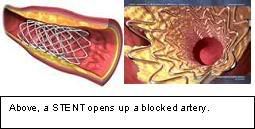
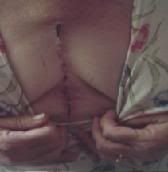
In 2008 I had a quadruple coronary bypass. This category in my blog details that experience, the lead-up, the after and living with the result.
I have been receiving many emails, thank you all, expressing concern for me and, I say with pride, many who have missed my missives.
This time, it's a brain infection. This time, it's a medical mystery that came out of nowhere, attacking the love of my life and husband of twenty years. This time America's wonderful health care system saved his life while the devoted medicos used the most advanced technology and the most creative solutions to deliver an 87 day cure without need of hospitalization.
Now I am his nurse. It's a job I take very seriously. For he WILL recover fully, on this I have faith.
Pic of the Day

"Last Day of Treatment-12/25/08"
I regarded the notation about the last day of 6-times a day antibiotic infusion would fall on 12/25/08 and the irony was not lost on me. For it will on Christmas day that my husband will be fully cured of a very nasty brain infection that has left his right hand almost useless and caused him four weeks of agony in terms of physical pain and the anxiety of determining just what was going on with his body. He will also have, or will shortly have, a new set of teeth.
It began as a cold. Just as soon as he walked in the door late one September 2008 afternoon husband complained of a plethora of "snot", as he ungraciously called it, in his throat and said he felt so bad he needed to lay down immediately. I put my hand on his forehead and noted that he was, indeed, very warm.
Over almost a two week period husband was alternately well or was frighteningly feverish. I did, as I always do with no desired result, beg him to go to the doctors. Husband never goes to any doctor unless he is half-dead. As it would turn out, that bit about being half-dead came very close to reality and again, it was his stubbornness and sudden dearth of common sense that made the situation far worse than it might have been. Because a nasty bacteria of some sort had, unbeknownst to him, invaded his lungs and proceeded onward to attack the command center of his being.
Which is not to lay any huge burden of blame on the poor man. He really did think that all he had was a nasty cold and he truly did believe that with rest and ibuprofin he would lick it. He has many times in the past, or so went his logic, so why not now?
It was on a Monday morning that husband finally asked me to drive him to medical help. That Monday followed a harrowing week during which he struggled to go to work and a weekend that had him feverish and weak. Only he didn't want me to drive him to the doctor. Husband told me he needed to go to the emergency room.
"He has a mass on his lung," a physician known as a "hospitalist" informed husband and I, this after a long day in the ER, receiving this test and that test and finally a CT of his lung.
I gulped. "Does this mean he has cancer?"
The hospitalist nodded affirmative. "Of course we need tests but yes, we assume it's cancer unless proven otherwise."
Husband was admitted to the hospital that day. Both of us had broken hearts, fear and deep sorrow at this sad turn of events.
It would turn out that the lung doctor, a physician known as a Pneumonologist, did not think what was showing on that CT scan was a tumor. He thought it was a very nasty infection, a case of pneumonia that had went on entirely too long. The radiologist took a different stance. He thought a biopsy should be done to rule out cancer. The site of discussion on husband's lung was located such that to get a tissue sample would require a trip upstate towards Wilmington to a hospital that does these things. Husband was admitted to Beebe Medical Center, the same hospital where I had my quadruple bypass. It's a great hospital but it's not Johns Hopkins, let's face it, here in the swamps of Delaware.
Husband was in the hospital for a week after that ER visit. He was infused with antibiotics and in due course he recovered rather nicely. We were both happy when he came home and we were especially relieved when the lung doctor informed us that the site of that nasty infection is improving and that he still did not think it was cancer. The protocol would be for husband to recover over a two week period as he took huge antibiotic pills and rested. After the infection was cleared, another CT would be done and a more definitive answer as to whether this was cancer would be forthcoming.
Husband did not recover after coming home. An appointment with the lung doctor was scheduled before he left the hospital so both of us figured he'd get better with the rest and medicine, take an out-patient CT to take another look at that lung, and that scheduled visit to the lung doc would be a formality that would bring an official release from medical care. Of course the pronouncement could have been a more certain diagnosis of cancer what with that infection out of the way to make such a determination easier. We prayed a lot. A whole bunch of people prayed for us as well.
Only husband deteriorated day by day during that two week period at home. His fever would spike and the only time it would go down was after that twice daily antibiotic pill. I again begged husband to go back to the hospital. He was supposed to be getting better. I might not be a vaunted medico, but this was a very sick man. Husband chose to wait it out until that scheduled visit to the lung doctor and after a new CT of his infected lung was obtained.
It was a brisk Fall Sunday, the day before that much anticipated visit to the lung doc, when husband lost the ability to move his thumb and fingers on his right hand. His hand hung uselessly by his side. He could not tie his shoes, he could not buckle his pants, he could not operate the mouse on his computer.
So okay...I was going to that lung doc with him the next day. Nothing about this man's condition was normal and when required, I have a big mouth. Okay, so I have a big mouth all the time but during this visit I intended to use it with a passion.
The good news was that the lung doc had the new CT of husband's lung and it appeared that it had been a nasty infection and it was healing well.
I wasn't buying it.
"He cannot use his hand," I told the doc, holding up the poor, sick man's hand and releasing it. Husband's hand dropped uselessly to his side.
"Further," I continued because this was MY chance to have my say, "he's still very, very sick. He has a fever all the time. The only time it goes down is when he takes that antibiotic. He's so weak he can barely walk. Doctor, this is a very sick man."
Both the doc and myself regarded husband, then sitting on the exam table and so damn sick it was as if he didn't care what me and the lung doc cooked up, he was sick and he wanted to be well.
"That he is," the lung doc said, that promising CT result sitting ignored on his desk. It didn't matter what the hell that CT showed, good or bad. Husband was sick. It didn't take a rocket scientist, or a doctorate, to see this.
I asked the lung doc could he have cancer, could that be why he is not getting well. That was the big question on our minds, of course. Lung cancer does not normally cause fevers except for the pneumonia it often brings about. Yet the pneumonia infection was virtually gone. And still husband was very sick and the loss of the use of his right hand made no sense at all.
Something called a bronchoscopy was scheduled for the following day. Hoops had to be jumped but the lung doc, he knew something wasn't right. A bronchoscopy, as the lung doc explained, will retrieve fluid and cells from the bronchial tubes. The fluid and cells would be examined and if cancer was present in the lung, some cancer cells would show up in the fluid. Again, the lung doc was trying to avoid a long trip for a very sick man to Wilmington if a simpler bronchoscopy would reveal the presence of cancer.
Which no one wanted husband's lung to be cancerous but after the prior harrowing three weeks, a diagnosis, however dire, would now be welcome. We couldn't go on not knowing what's making him ill, not having a proper medical protocol to deal with his illness for lack of a diagnosis.
We showed up for the bronchoscopy at 6:30 in the am, yes we did. This is a fairly simple out-patient procedure but it does require about an hour recovery for the anesthesia.
"I tried to get you scheduled for a CT of your husband's head downstairs but they can't get him in until after three today. I want you to go down the street to the Acme Xray clinic and have it done at noon."
This was a surprise. The road leading to and from Beebe Medical center is filled with medical offices, much like the area around most hospitals. The lung doc was doing his best to keep still sick husband and me from hanging around so he arranged this CT of husband's head in one of those clinics along Route 9 so we could get it done on our way home.
The next day the lung doc called. The bronchoscopy revealed no cancer cells. So this was good. BUT that CT revealed an infection in husband's brain.
Husband and I were both shocked. An infection in the brain?
Now we'd heard of a brain infection, mostly from reading about that MRSP thing, that staph bacteria which has proven impervious to all modern antibiotics. A few years ago husband's own mother warned of infections to the brain caused by bad teeth. She begged her son to get his teeth fixed to avoid this very thing.
Which brings up the issue of husband's teeth and let me flash forward here. A subsequent MRI revealed FIVE abscesses on husband's brain. The guy was in serious condition and, indeed, as the infectious disease specialist brought in to help with the lung doc’s diagnosis, the infection from the pneumonia crossed into his brain via some open path in his teeth.
I have wanted my husband to get his teeth fixed for about forever. His mother's pleas didn't get any traction either. She had warned about cases of brain infections caused by bad teeth and she was right.
At the time my logic in wanting husband's teeth fixed was based more on his increasing inability to eat properly. With each passing year I had to make his food softer and softer. Once he had to be rushed to a hospital in Baltimore for a piece of meat lodged in his throat, such was his inability to chew his food. I had no understanding of this concept of brain infections caused by bad teeth but did it matter? In order to get proper dental care, the very first thing required is the desire and participation of the dental patient. Husband figured his teeth did not hurt, he did not have bad breath, he brushed and took care of his teeth with a religious fervor. He knew that someday he would have to deal with the matter. His greatest crime was putting it off. Like how he put off getting his brakes fixed until they suddenly failed to stop the car. Like how he put off getting his muffler fixed until it started dragging on the road causing sparks to fly and other drivers to point out the danger.
Husband's middle name is procrastination. My only defense as his loving wife is to take over whatever task he procrastinates on and hey, he goes to work every day, I stay home and take care of everything else.
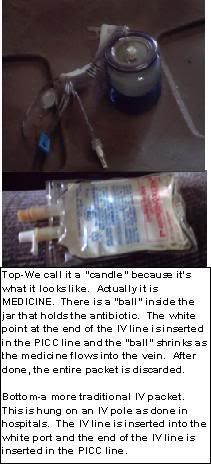
The lung doc, who is husband’s primary physician now, asked us to return to the Acme Xray and Drive Thru MRI place to get an MRI of that brain.
“He has FIVE abscesses in his brain. He wants to wait till Monday. Mrs. Fish if this was cancer he COULD wait till Monday. He needs to get to the hospital now or else he’s going to die.”
Damn if that stubborn man didn’t refuse to go to the hospital when the lung doc called with the ominous result of that on-the-fly MRI. It was a Thursday night. Husband told the lung doc he could maybe get to the hospital by Monday. Lung doc did the only right thing…HE CALLED ME!
Needless to say the hubs and I reported to the hospital at 7 pm that Thursday night. I took him out to buy him a pizza, we packed clothes and toiletries for a hospital stay, he took long breaths of fresh air and off we were for another week long stay at Beebe medical center.
Five abscesses in his brain? My mind reeled. Yes, abscesses! Boils in other words. In his brain!
The medicos flooded the man’s body with antibiotics for a week during that hospital stay. Meanwhile he was tested for HIV (negative) and other stuff and in due course the infectious disease doc, called in for consult by the lung guy, declares that the hubs’ pneumonia infection had crossed into his brain through his bad teeth.
“It’s a classic case of brain infection via diseased teeth,” the infectious guy told us.
Casting aside blame and aspersions as to just who was guilty of procrastinating to the point of death for the moment, the protocol for “curing” the man’s infected brain boggled our minds.
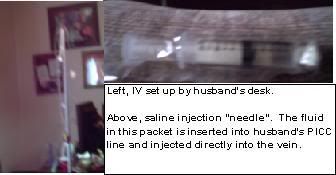
The man must be infused with antibiotics SIX TIMES A DAY! Yes, intravenously. In other words, directly into his body via something called a PICC line.
This PICC line is a semi-permanent tube that is run through a great big vein of some sort in the arm directly to the vena cava of the heart. The PICC line can be left in place for up to a year and yes the man now walks around with TWO ports of access/withdrawal to his circulatory system hanging out of his arm. The two portals to his blood stream bounce around when not in use.
“We’re going to teach YOU how to do it,” the case manager told me as the date for husband’s release came closer. The alternative was to have the man put in a nursing home, an option totally out of the question.
The man certainly should have tended to his teeth sooner and for that bit of procrastination he surely had already paid dearly. To lock him away somewhere away from his family for two solid months, during the holidays no less, was unthinkable. He’d surely curl up into a ball and die.
But the notion that I, arguably a master of the language and the spreadsheet but nobody’s medico, would be injecting husband with saline solution, cleaning his PICC points, hanging his bag IV and twice a day hooking up and administering what is called a “ready-made” IV…well this gave me great pause.
The bag IV’s must be administered four times a day, every six hours. The ready made IV must be administered twice a day, every twelve hours. During his stay in the hospital husband had a seizure, a reaction to a brand of medicine that is known to possibly cause seizures. Add to my job of delivering antibiotics via the PICC line, I was quite concerned about the possibility of another seizure, this when he wouldn’t be in a hospital for instant care. I was assured that the offending medicine was stopped and the possibility of more seizures was slight. In addition he would be given an anti-seizure medication that would also help.
Arrangements were made for a home nurse visit to come, three times initially to train me on the IV treatments. We now have a home nurse come once a week. The antibiotics are delivered directly to the house once a week (a week’s supply) and two huge boxes of supplies were awaiting us when we returned home after release from the hospital.
I, as my efficient and organized self is wont to do, have separated all supplies needed for each type of IV treatment into separate bags. The ready-made antibiotic needs to be refrigerated and thank God we have a separate fridge in the garage cause those jar things take up a lot of room.
I was scared out of my mind at first. It’s difficult for a lay person such as myself to get over the notion that I am injecting fluid directly into a human’s blood stream, directly into his heart! The visiting nurse, God bless this woman who came once at 1 am in the morning to continue training me, was patient and detailed in her instruction. She wrote down instructions for administering each type of antibiotic and oversaw me doing two of the bag IV and one of the ready made before leaving me on my own.
It’s no picnic, let’s not sugar-coat this. One IV has to be administered at one in the AM. I’m not one to sleep sound at 9 pm in the eve but I’m rarely up at one in the AM. So I must awake at 1AM to begin the middle of the night IV treatment. And it’s not enough to stumble in and hook the man up. I have to stay up until the antibiotic bag is empty. This treatment takes an hour to get it all into the bloodstream. Which leaves me not going back to sleep until two in the AM. I must get up at 6:30 in the AM to begin the next treatment.
But don’t cry for me Argentina. I don’t work (I don’t know what couples who both work do in this situation. I guess there are times when one must go into some sort of nursing type home) and I can get naps during the day. I have a DVR and can shift the times of my favorite TV shows, God Bless America. I can now be found watching “Desperate Housewives” from 1 am to 2 am in the morn. With a little ingenuity and, well hell yeah, a lot of love, anything’s possible.
The nurses tell me that it is possible for folks to administer this IV themselves and, indeed, they have plenty of patients who do this. The PICC lines have what are called “extenders” and these allow the IV lines in the arm to be reached with one’s hands. Husband, as it is, has lost the use of his fingers on his right hand and those extenders wouldn’t help him a bit. With treatment his hand is starting to work again. The other day he was actually able to tie his shoes! I thought I’d never see the day when such a small thing would bring two people such great joy.
He can also drive and he drove the other day. I’m a bit nervous and I don’t think he should be out driving by himself any time soon. But he was able to drive that Jeep pretty handily and if we can manage to get out between treatment times, he gets around fairly well.
We already have an appointment with an oral surgeon as the act of extracting his teeth is going to be very tricky. He has to be solidly in the middle of this massive antibiotic protocol for all this dental work to take place. His brain has already been infected from some mysterious route through his teeth so this oral surgery will have to be timed perfectly. Tentatively it is planned to begin the protocol around the first of December. Every one of his teeth will likely have to be extracted although I don’t know about his back teeth. He will have to immediately be fitted with a form to begin preparing false teeth. Husband is already very underweight from all of this so he will likely need additional liquid supplement while he awaits his new teeth and learns to get used to them.
Frankly I don’t know what lies ahead. But his job is working with him to put him on short term disability and thank goodness we will still have our health insurance.
Yes, it’s been quite a year here in the Fishbowl but prayers and good wishes of many have helped.
In 2009 I hope to post a picture of very handsome husband, all well and with a brand new set of teeth.
Wish us luck.
============================================
I go back and read the above and ponder what it was like. I remember how husband would walk solidly and proudly, proclaiming how "hopeful" he was for a full recovery. I recall those times when I hoisted myself up from a deep sleep after midnight to give the man his Mid of Night IV. It wasn't easy, but I too, was "hopeful". It was a labor of love.
I read the last two paragraphs wherein I consider the New Year, a healthy husband, a brand new set of teeth.
As I write this it is three days before Christmas. Sadly, nothing turned out as it was to have been. Husband's last day of intravenous treatment will NOT be on Christmas day as originally planned. Although we had so much hope, alas it was not to be.
Which is not to say, this three days before the blessed birth of our Savior, that all is bleak. But it sure was a dark and depressing time before now, when we once again have hope.
It was the seizures. They were awful.
Seizures have never been known to be pleasant things. This is a given. But on a horrific rainy night in mid-November, husband suddenly went into a seizure that lasted, as measured, over an hour. This was not a seizure as I reason. It was husband's brain. His brain was dying. His brain was killing him.
In the above missive I note that one seizure is mentioned. Husband had another Grand Mal seizure on election night. I came out to administer another infusion and husband was leaning on the television. He was breathing deep and hard. "Pat," he managed to gasp. "I had another one of those seizures." He was referring to his first awful seizure that he had while still in Beebe Medical Center.
"I have to call an ambulance," I shouted, taking out my cell phone and calling 911. Indeed I had been told that in the event husband had a seizure I was to call the paramedics immediately.
"No," husband gasped. "I can't go to the hospital like this."
He was very weak after the seizure and as I struggled with the cell phone I noted he was struggling to get into the shower.
He'd lost control of his bowels. He was trying to get into the shower. He was not allowed to take a shower unless his PICC lines were covered with plastic. The PICC lines could not get wet.
I ran and got clean socks, jeans and underwear. I stripped his clothes off. With one hand I spoke into the cell phone to the paramedics then en route. With the other I cleaned up husband's entire body, wiping him down from top to bottom, rinsing the hand towel in the sink, wiping him again. Still holding the cell phone with the paramedic on the line, I put clean underwear and socks on husband then slipped him into clean jeans.
He was entitled to his dignity. No one should have to suffer the humiliation of being handled in the shape he was in. Without blinking an eye I took care of him, never once did I wince or shy away from the task. I would, with all the love in the world, clean him up and make him comfortable for being seen by strangers. His pathetic attempts to work the shower made me want to weep.
It was the "worst" of "for better or worse" and yet I did it with love and I'd do it again in a wink.
The paramedics came, noted husband's shallow and irregular breathing and said he needed to go to the ER right away.
It was election night. I spent several hours in the ER watching the election returns.
"When he has a seizure you don't have to bring him into the ER," the ER nurse told me. Husband was then receiving a liquid infusion of an anti-seizure medication called Keppera. In fact he was taking this medication at home but, it would seem, not in large enough quantities to prevent seizures. "Just sit him down somewhere where he can't hurt himself for the thrashing. Seizures only last about 90 seconds."
Well I wasn't about to do anything of the sort until I consulted with the home nurse in charge of our case. While I was an ersatz nurse doing infusions and such, I am an accountant, a wannabe writer. If the nurses told me not to take husband to hospital after, or during, a seizure, than I would not. It was these same Home nurses who originally told me to immediately get him to an ER with a seizure never mind what that ER nurse told me.
We were both delighted that husband would not have to be readmitted to the hospital. For sure we both knew that husband's seizures, for they were now in multiple, were not caused by any allergic reaction to medicine, like we'd been told after that Grand Mal he had in the hospital. In fact husband's own Keppera prescriptive daily intake was doubled after this seizure, from 500MG a day to 1000MG a day.
It wasn't enough.
In fact husband had a petit mal seizure right in the damn Neurologist's office, how's that for timing? I watched his head bob round and round. The Neurologist receptionist had screamed for the doctor as my husband said, calmly I thought, "I'm having a seizure right now."
The Neurologist thought husband had cancer and thought he should go upstate and have a biopsy. During said biopsy husband would have a needle stuck in his brain and some of the fluid from one of those lesions would be removed. This biopsy would, allegedly, do one of two things: it would verify that he had cancer of the brain or it would allow a more detailed study of just what kind of bacteria he had attacking his brain matter.
Husband's Infectious Disease doctor was having none of it. For I'd phoned this doctor up the next day, complaining about the Neurologist's command that we move husband upstate, that he thought husband had brain cancer. "Don't pay any attention to him," the Infectious Disease doctor told husband. "He's a Neurologist. He sees cancer everywhere."
The Infectious Disease doctor was in charge of husband's care. There was, as delineated, a Neurologist as a consultant to monitor seizure activity, as well as a Lung doctor to watch husband's tricky breathing and the first doctor assigned to him as this all began with a bout of pneumonia. Sadly, while there were a plethora of doctors supposedly taking care of husband, they didn't talk to each other and this fact, I believe, almost killed him.
It was four days after husband's visit to the Neurologist that he had that seizure which almost killed him. The Neurologist had given husband yet another anti-seizure medicine, a medication used to treat bipolar disorder. It was from a drug sample pack. His Keppera was NOT increased. Keppera is the prevailing anti-seizure medication.
I'd been in the shower. When I came out I saw the most heartbreaking sight I'd seen in my lifetime. For husband was sitting on the floor by his bathroom. His entire body was thrashing about uncontrollably. I quite literally felt my heart sink to the floor.
I ran over and sat on the floor next to husband's uncontrollably thrashing body. Remembering that ER nurse's suggestion that I not call an ambulance in the event of a seizure, a suggestion that the Home nurse agreed with, I just took him in my arms, intending to hold him tight until the seizure passed. It would only last 90 seconds or so, or so I'd been told.
I watched the clock. Five minutes ticked by. Still husband's body thrashed violently. Ten minutes ticked by. "Honey, I've got to call an ambulance. This is just not right," I told husband as I disentangled myself from his thrashing body. Husband let out a loud moan of protest. I knew he didn't want to go to the hospital; I knew he was afraid of being readmitted. I also knew, no matter what the hell a nurse of any kind, either ER or Home, said, that this was just not normal.
I waited fifteen agonizing minutes for the ambulance to come. During the entire time husband thrashed all over the floor. It was the longest time span, and the most heartbreaking, I'd spent in my life. Husband was in "there" when he had these seizures. He was very aware of what was going on around him. He just had no control over his body, none whatsoever. The paramedic dispatcher remained on the phone with me. I kept telling him over and over that this seizure shows no signs of letting up. Husband was flopping about everywhere.
The paramedics came in and without delay one they put husband on the gurney. I heard one paramedic tell the hospital ER that they would be getting no damn vital signs, that this man was in full Grand Mal seizure and had been for at least the last fifteen minutes.
Actually husband's seizure lasted at least an hour, probably more. He told me that he'd been seizing at least ten minutes before I finally came in and found him. This may or may not be correct as it's questionable how well he measured time while in the throes of a Grand Mal. I know for sure that I waited ten minutes with him awaiting the seizure to end. Then it took fifteen minutes for the ambulance to arrive. I followed the ambulance to the hospital. It took fifteen minutes to get to the hospital. I followed the ambulance in my car. I ran up to the ambulance as they were unloading him and STILL he was seizing.
It took the hospital about fifteen minutes to stop the seizure via an infusion of Keppera. By this time the man was a total mess.
His speech was terribly slurred. He could not move either of his arms. The hospital personnel tried various tests to ascertain the extent of the damage. "He may have had a stroke," the ER doctor told me quietly. I sobbed the heartbreak of the damned.
His breathing was labored. He could not move his arms or his legs. It was anybody's guess how badly his body was damaged. And still, he began to SEIZE AGAIN! It wasn't a Grand Mal, but his eyebrows began to go up and down, his head wobbled around. The ER doctor said he was at the end of his rope. "I've got to go make some phone calls," he said, then disappeared. I sat by husband's side and spoke quietly to him. He was there, he understood me. He knew he was in terrible shape. I loved him so very much. I prayed to God to please, please give me some of his pain. No, I wasn't brave enough to take it all. But I'd happily take some of his seizure if halving the violence of his thrashing would save him. I'd take a couple of those brain lesions if somehow we could both live that way. It was twisted logic but it seemed so unfair that HE should have the suffering.
"There's nothing more we can do for him, Mrs. Fish," the ER doc told me soberly. "I suggest moving him upstate where they've got more experience in these things. I spoke to Christiana Care and they're willing to send down an ambulance to take him up."
We live in a beautiful but rather backwoods part of Delaware. I'd never given it a thought as to what sort of medical care might be available before moving here but who the hell would ever think of such as having a brain infection? Northern Delaware, up near Wilmington, is obviously more sophisticated, more likely to have doctors able to handle this odd medical condition. I wondered why the local doctors didn't admit they were in over their heads earlier on, long before husband almost died from a medical protocol that obviously wasn't working.
We both worked so hard. I was giving him six infusions a day, at all hours of the day and night. We'd been hopeful. Yet he kept having seizures, seizures actually witnessed by all manner of medical personnel. One seizure occurred right in the Neurologist's office!
But they never connected the dots.
It was his medicine, they told me. He's allergic to his medicine.
Don't worry, another medico told me. Seizures only last 90 seconds. Keep him calm and safe and he'll be okay.
The Neurologist gave him drug store medicine samples.
The Infectious Disease doctor wanted to fight with the Neurologist.
Obviously the protocol as prescribed wasn't working. He was having seizures constantly. His right leg was getting wobbly. I told the ID doctor this very same thing on the phone one day. "Is he getting worse?" he asked me. I considered his wobbly right leg, the lack of improvement in his right arm. "Yes," I told the ID doc. Me. I was the one with husband 24 hours a day, seven days a week. I got eyeballs.
No one listened. The doctors didn't even talk to each other.
"His breathing is very labored," the ER doctor whispered to me. "We can't transport him in this shape. Plus we can't get the seizures to stop." I looked sadly at husband, still with his eyebrows going up and down, still with his head going round and round.
"We'll have to sedate him. We'll have to intubate him. It will take an hour and a half for the upstate guys to get here. And another hour and a half to get him back up north. Plus there's an awful storm up that way. I'm not at all sure he'll survive if we don't get him calm and ease his breathing."
I drove myself home. I kissed husband goodbye before they put in the tube, before they sedated him, not at all sure if I'd ever see him again. There was nothing more I could do. I was told to call Christiana hospital the next day to check if he'd arrived safely. If there was any problem they would call me. I sobbed. I could only hope that my cell phone did NOT ring that night.
Thus began another long and incredible medical odyssey that this wonderful man would endure. As of this writing, well we still have hope. But it was a terrible time, a long and arduous journey.
I dare to hope my prayers were answered.
=================================
And so began yet another long medical journey. Only this time husband began the journey in much worse shape than the first time in what seemed so long ago in October of 2008.
I went home alone that night of the endless seizure. I know now that what husband had was not a seizure at all. At least not in the conventional meaning of the word. His brain was dying. The antibiotic protocol was not doing the job. The man had FIVE lesions in his brain! They had been referred to as "boils", "pimples" and "abscesses" by various medicos. His medical protocol required a very aggressive antibiotic treatment. So while his doctors had him on six infusions of antibiotics a day, it was not enough. The lesions were winning. The infection grew until his brain went into a massive meltdown. Parts of his brain were misfiring and his body was thrashing in response to a brain command that made no sense. Had that so-called "seizure" continued, and it showed no sign of stopping, he would have either had a stroke or a brain rupture.
By the time husband got to upper Delaware's Christiana Care Hospital his brain was swollen, his body racked. It was up to the doctors in the north to try and save this man. They would not have the advantage of a walking, talking human being on which to work their craft. Their patient was an unconscious fellow whose name they did not know, who'd never stepped foot in their office, whose recent medical history was unknown to them beyond a voluminous pile of papers sent along with him as he left Beebe Medical Center by ambulance.
Early the next morning, after not sleeping a wink for worry, prayers and a sad acceptance that my husband would likely not survive this, I called husband's mother then called my daughter.
"I need you here," I told her. "I can't do this by myself."
Which was true. There was simply no way my beleaguered and weary self could manage get through that day without help. I would begin a three hour trial to try and get an update on my husband, notify husband's family and try to answer their questions, and most difficult of all, find our how to get to that hospital.
In fact I'd never been anywhere north of Sussex county in Delaware although I understood that Delaware had a total of THREE counties, imagine that! And anywhere around or near Wilmington scared the living daylights out of me. Christiana Care hospital was located right outside of Wilmington, in Newark, Delaware. I was never all that good at finding places even with the might of Mapquest and ownership of a Tom-Tom. Add to this personal deficit, I was overwhelmed with my fear, concern, and worry.
At that time, it was anybody's guess as to what husband would look like when I finally arrived at the hospital. My fear of that sad sight, my worry about navigating around a huge hospital, my loneliness at being alone in my house where husband and I had worked so hard to get him well, where we had such hope...I needed someone and that someone was my daughter.
Even though my daughter had only one car which was that day being used by her husband for work, even though she has a child that needed minding for the weekend, even through it all, she maneuvered and manipulated friends, families and in-laws and around 2 pm that Saturday she arrived ready to spend the entire weekend with me.
Meanwhile I'd managed to get an answer about husband's condition. I got a room number and information that he was still heavily sedated and still with a breathing tube down his throat. I got the location of the hospital on Mapquest and also plugged it in on my Tom-Tom. Daughter would drive the Jeep, as I figured, and I would navigate.
Nothing could have prepared me for the sight of my husband when daughter and I finally arrived at the hospital early that evening. Nothing at all.
There was no sadder sight on the planet and in my horror I shouted out his name, in the ICU where husband was moved to earlier in the day, and began to sob.
Husband was unconscious with a tube down his throat. His head was covered with wires hooked up for an EEG that was then being administered. I knew it would be bad. This was worse than I'd imagined.
Various medicos rushed to my side to assure me that even though it looked like a scene out of Frankenstine that husband was just getting an EEG, that various tests showed that his brain was a bit swollen but still seemed to be functioning, that he was being kept sedated to get the brain swell down and was not in a coma, that all of his body's physiological functions appeared to be working well.
I knew that just the evening before husband and I had enjoyed a pizza at a local eatery, that we'd come home to a warm home, that he lay down for a rest while I took a shower. He was walking and talking and living his life. Now he had a tube down his throat, was unaware of the world around him, had wires affixed weirdly to his head and had a badly swollen brain.
Thus I sobbed my dismay at it all, never mind the reassurance of the medicos. What went so terribly wrong?
Husband was in that semi-coma in Christiana Hospital's ICU for five full days. However, he DID recognize me. The first two days daughter and I drove up to the hospital. I appreciated her presence more than ever. She drove the Jeep for the hour and a half trip each way, she was with me when the horror of husband's condition first shocked me, she spent the night with me, just me and her, me sobbing that he'll never survive, she assuring me that this was not the assessment of the medicos at Delaware's Christiana Care Hospital.
Right from the start and from somewhere deep under the sedation, husband greeted me during each visit. I would ask him if he knew who I was. Struggling to speak with that tube down his throat, he would mumble "my wife". Each time as I first arrived for a visit, after I walked into the room and gave him a happy greeting, he would smile. It was an awkward smile, made awkward by that breathing tube. But it was definitely a smile. I cried tears of joy at that strange smile every time I saw it.
Sometimes he could only squeeze my hand when I asked him to do so, if he knew I was there, if he still loved me, if he knew I loved him.
Husband's family was in constant contact with me after this event. His mother and brother live in Massachusetts while his sister lives in Florida. There was concern that he might not survive. They were facing a godawful decision: do they come to visit while he is alive but so sedated he might not even know them or do they await to come to his funeral? His siblings have families, jobs, responsibilities. His mother was an emotional wreck. This was all a week before Thanksgiving. So there was the pressure of how to work around this for their own families and the brother that they feared they might lose.
It was Wednesday a week a day before Thanksgiving when they finally got that breathing tube out and husband began to breathe on his own. His heavy sedation was gradually decreased to bring him to a full consciousness. I'd been promised that the tube would be pulled the day prior but upon arrival I was disappointed to find out that the tube would have to stay another day, that he'd had an "apnea" event that lasted 20 seconds. As a sleep apnea patient myself, I knew what the word meant. I sobbed. Would I be placed in the position of having to remove that breathing tube to have him die because his ability to breathe on his own was damaged by that horrific seizure? It was after this event that husband's mother and brother got on an airplane and came down. His mother was prepared to stay until he either recovered enough that she knew he would live or she was prepared to attend his funeral. There would no Thanksgiving for either of us this year.
While husband was under that sedation the doctors had performed a bevy of tests on him. He had two bronchoscopies. He'd already had one of these down this way but it seemed that no one at Christiana Care cared one whit what tests and/or diagnoses were done down here in southern Delaware. They began to treat the man as if he'd never been seen by another doctor anywhere.
Husband also had MRI's, Cat Scans, heart probes and goodness knows how many tests. I had to sign for them all as, of course, he could not. There was also the suggestion that he might have to have a brain biopsy to totally eliminate brain cancer as a possibility.
To add to all the harm done to this man, his PICC lines somehow became infected. PICC lines are actual IV lines inserted into a patient's arm, up over his shoulder and directly into a valve in his or her heart. Two "faucets" hung out of his arm. In one I would infuse him with his antibiotic. The other could be used to draw blood. This kept patients from constantly having to be stuck for intravenous injections or to draw blood.
PICC lines are tricky things however. I'd been trained to always wash my hands right before giving him an infusion. Still he managed to get a candida infection. Both of his arms swelled up like Popeye’s. The poor man had to have new PICC lines inserted directly into his neck.
It was a confusing, harrowing time. Husband's mother had come and was staying at my house. Her and I were both being constantly told so many things about husband's condition that we began to squabble between the two of us. There were so many doctors involved in some fashion with his care. I understand it now. The man had a brain infection. By the very fact that it was an infection an Infectious Disease doctor was involved. Since his brain was involved, a Neurologist was called in for a consult. The hospital itself had Residents in charge of husband's care and he was made part of a study for his PICC line infection.
Some of the doctors told me that he might need a biopsy of his brain. At first this concept was bandied about as a way to get a tissue sample to make sure the man did not have cancer in his brain. Then the notion was advanced that it might be a good idea to get some of that infectious fluid in his brain to better determine the type of bacteria attacking him.
Husband had continually fought the idea of having a needle go in his brain. I'm not sure where he was coming from because I'd reached a point in my terror that I figured it was time to go the ultimate route and eliminate brain cancer as a possibility. Husband was even quite brave about the possibility that he might have cancer. "Just let me go home and keep me comfortable," he said rather matter-of-factly. But a brain biopsy was fraught with problems, including possible death, paralysis, and further infection. All MRI's of his brain had shown lesions in his brain, FIVE of them. Brain cancer just does not normally present this way.
Husband’s attitude about a brain biopsy changed considerably once he was laying in a bed with a tube down his throat. For I had been charged with signing off on all of his tests. His very last request before he was sedated and intubated for that long trip by ambulance up north was that he NOT have a needle stuck in his head. Once that tube came out of his throat and it was ascertained that he was still “there” with a full mental capacity, I asked him in front of his mother and his brother if he wanted to have a brain biopsy as so many of those doctors responsible for his care were suggesting.
“YES” he almost shouted, even with his then slurred speech he was very understandable.
The only problem was that the doctor directly in charge of his care did NOT recommend a biopsy of the brain.
“He has lesions in his brain that we think got there from the pneumonia he had in late September,” Christiana Care’s Infectious Disease doctor told us. Well this was nothing new. This had been the diagnosis right along. It was only the treatment protocol that went awry.
“We think he should have a brain biopsy,” the Christiana Care resident in charge of husband’s case told us. Now we were all confused.
“He has a bunch of pimples in his brain,” a Neurologist consulted by the hospital told me. “If we don’t get them down he’s going to die.”
Again, I knew this.
Husband’s mother thought the medicos ought to do a brain biopsy and wondered why they were waiting around. I tended to agree with her but was frankly so confused I did not know what to believe. That diagnosis of a brain infection caused by entry of a pneumonic bacteria via his teeth had been the prevailing diagnosis in two places by two sets of medicos consulted on his case. The Neurologist in northern Delaware did, as did the one down south, wanted to stick a needle in husband’s brain.
“We’re going to aggressively treat your husband with an antibiotic regimen. He’s very sick and we need to get him up and active again. For every day your husband was in that extreme state of sedation he will need three days to recover. We’re going to get to know this guy for a while.”
Myself, mother-in-law, brother-in-law and now husband’s sister who flew in from Florida, listened to this summary by the Infectious Disease doctor. None of us said a word. Husband’s sister is, by the way, a nurse. I was so happy to have her here and get her input on this situation.
Although frankly I was quite confused because there was absolutely nothing new with this diagnosis OR the proposed treatment. Except, of course, husband was a total mess now, not the vibrant, hopeful man he had been when this all began back in mid-October 2008.
Husband could not move a limb on his body. Both of his arms were swollen and almost useless. His legs simply did not work no matter how much he commanded them to do so. After his tube was removed from his throat he was moved out of the hospital’s ICU where he had been for six days. He had a catheter removing his urine and there was no need for dealing with such as solid waste as the man had not a thing to eat for an entire week that he had been at Christiana Hospital.
“I’m whipped, Pat” husband told me as the overhead crane in the hospital room carried him from the transport gurney from the ICU to place him in the hospital bed in his new room. “I am completely at the mercy of other people.”
He was crying. I sobbed too at that sad truth. He only weighed 115 pounds by this time. While he is a small man, he normally weighs in at around 140 pounds.
Every day his mother and I traveled the hour and a half drive each way to visit him. He was a sad sight, practically swallowed up by the hospital bed. After leaving the ICU he was given food for the first time. Only his esophagus was so sore after so many hours with that breathing tube that he had to have very soft food.
Slowly he began to look better. For sure he was a long way from where he had once been but he suffered no cognitive loss of his intelligence, his memory was still all there. He did have a slight case of paranoia and he was convinced various hospital personnel were trying to kill him. In my reading on brain infections I’d read that victims, even after a complete cure, often suffer personality changes that are permanent. I shuddered at the thought that husband’s personality change might be such paranoia and delusions.
“Do you have a cat named Lisa?” the nurse asked during one visit. I told her that we did.
“He had a very rough night. All night he kept yelling that Lisa was under the bed and he wanted me to crawl under and get her,” the nurse told me.
In fact husband suffered many delusions and most concerned our pets. He was convinced one of our cats was out on some sort of loading dock and he wanted me to get him before he got hurt. He also said the dog came to visit him and that everybody on the floor loved and petted her.
There were delusions of rats and bugs all over the walls, more normal delusions one might say.
It was slow but soon enough the delusions stopped. He began to move his legs and the arm-swelling began to go down. The catheter was removed and then began his attempt to urinate while in bed with one completely useless arm. Husband is a proud man and he hated to bother the nurses with helping him to urinate. One morning I called him and heard the distress in his voice.
“I tried to pee in the jar, Pat. But it was in the middle of the night and there was already pee in it from earlier. But I really had to go. Only my arm doesn’t work and while I tried to wrestle with the jar under all these covers some of the pee in the jar came out and got all over the bed. I cried I felt so bad. They had to come in and strip my entire bed.”
I cried too. What an awful position to be in. He only wanted to pee in the jar sitting on his table for that very purpose. For whatever reason the jar had not been emptied from earlier. Husband being the sweet soul he is didn’t want to ring the nurse’s bell to summon someone just to empty the jar. But he only had one arm that worked and his other arm was very weak. On top of all his suffering he had to endure this humiliation.
He had problems eating his food as well. He could not cut his food what with one working arm. For breakfast they bought him a small box of corn flakes. Only he could not open the paper inside the box due to that useless arm. He was hungry and really wanted those corn flakes. Most times he just went hungry rather than bother the nursing personnel for what he considered such inconsequential stuff.
When I was there I made sure his food was cut, his bread was buttered, his drank was safe from spillage. I also shaved his face and washed his hair.
The hospital had people to do this stuff but I didn’t think it was done often enough. I don’t think they even gave a thought to this poor man with a useless arm and how difficult it was for him to even do a simple act of drinking from a cup with only one very weak arm to guide it to his lips. For sure he could not shave himself. His mother and I went to Walmart and she bought him an electric shaver that held the shaving cream inside of it, could be used under water and was much safer than a razor. It cost $78 but was worth every dime of it.
The big event before any update on husband’s condition was a new MRI scheduled five days after his removal from the ICU. By that time he had been at Christiana Care hospital for about ten days. At the time of his arrival via ambulance an MRI was done. If those brain lesions had shrunk even slightly after that ten day regimen of antibiotics then the diagnosis would be deemed as correct and efforts would be made for the next stage of his recovery.
“The lesions have shrunk,” the Infectious Disease doctor told us with a smile. Mother-in-law and I were so grateful. We had been, in an awkward layman’s fashion, monitoring the meds being given to husband. He was being given the same ones that he had been receiving during that two week period of home care before that horrific seizure. BUT there was a big difference.
Husband was also receiving one more antibiotic than what he had been receiving at home, almost triple the Keppera, the medicine that deters seizures, AND Dilantin, another medicine use to control seizures. His medical regimen in this hospital in the north of Delaware was far more aggressive than had been part of his medical protocol here in the south. His arm swelling went down and a PICC line was put into his left arm. That new drug by Pfizer had effectively quelled the fungus that had been in his blood from the PICC line installed down south.
On December 3, 2008, husband was moved south, way further south than even where we lived in southern Delaware. He was transferred, by ambulance again, to Chesapeake Rehabilitation Center in Salisbury, Maryland.
He could not come straight home like the last time. Husband could not walk and I, who had a quadruple coronary bypass this past May I remind, could not possibly carry him around or even help him navigate much. He needed rehabilitation but not the intensive medical care of a hospital.
The improvement in husband’s condition was almost geometrical on a daily basis. I began to almost have hope again. Still he could not walk on his own and his right hand was as yet almost completely useless. He did have one small petit mal seizure while in Christiana Care. The doctors immediately increased his Keppera but it’s notable that even then, after almost eight weeks of antibiotic therapy his brain still continued to seize. I wondered on what basis those doctors responsible for his earlier care came up with a medical protocol that him getting 1000 MG of Keppera, back then when he had only began his antibiotic therapy that was to last eight full weeks. As of this writing husband is on 3000MG of Keppera daily. Not to mention the robust antibiotic therapy he was given up north and STILL his brain was seizing, however slight. Early on in his medical protocol the poor man had been a walking advertisement for death by stroke or brain rupture and we never had a clue.
Chesapeake Rehabilitation Center was pretty much what the name implies. Husband was up and walking with a walker within three days of his arrival. Within a week he was walking on his own. His arms were both working. His right arm gained strength and was or more use every day. On the day he told me he could tie his shoes we both sat and cried with joy. Who could ever think such a simple act would be greeted as a major victory in such a long road to recovery?
Husband continued to have small seizures, more like sudden ripples in his limbs than technically a seizure in the purest sense of the word. They monitored him closely in the Rehabilitation Center. We were told that he might have scarring in his brain and he will likely always need anti-seizure medication.
Which we can live with, of course. I still have terror because of that awful night of the hour long seizure but feel comfortable that the doctors in charge of his care now do not take seizures lightly.
There would be one more horrific surprise to come from this medical odyssey.
“They sent my medical records down from Christiana Care,” husband told me one day. “For some reason it came to me. I opened it up and read everything I could. A lot of it made no sense to me but right on the front page it said I have a history of “severe alcohol abuse.”
One could see the steam rising from my head.
Hadn’t this poor man suffered enough? First they don’t give him the correct amount of antibiotics. Then they toss off his seizures as if they were nothing, just blips in a daily life. Now we find out that some fool or another declared this man a serious abuser of alcohol and who could have come up with that blatant lie?
While his huge file came from Christiana, we were quite sure that bit about alcohol abuse did not come from that hospital. For goodness sake the man was sedated with a tube down his throat when he arrived at that hospital. I sure didn’t tell anyone the man abused alcohol. This would be because he most certainly does NOT. In 20 years of marriage I have never seen the man drunk. He has 30 years of perfect attendance at Sears and with his current employer (YES this alleged drunk had a job that continued to pay him even though all his sick time had run out!) he had five years of perfect attendance. He does drink beer, only at 10 pm and only in his own home, just a couple perhaps to make him sleepy. Some 95% of American men drink beer and I wonder if their files would call them severe alcohol abusers? In addition, husband did not drink a single beer throughout this entire medical nightmare when it began way back in October of 2008 even though he was never told not to by these fine medical folk who got this fact so very wrong. Husband feared any alcohol might trigger seizures.
Husband is a wonderful, kind and gentle man and any nurse or medico who worked on him would agree. I was always receiving compliments by those responsible for his care that he was such an agreeable man and a joy to be around. His case manager at Chesapeake scanned his file and said there was absolutely nothing in it that would indicate an alcohol problem. She wondered how on earth such a notation got in his record. She too agreed that husband was well-liked by his caregivers at the Rehab center and they all noted how hard he worked towards his recovery and what a sweet disposition he had for one who had been through so much.
When I found that terrible lie was in his file I immediately called the nurse assigned to husband’s case by the health insurer.
The nurse at the health insurer was livid. “You should check his medications,” she told me. “Alcohol abusers are often given specific medicines. If he’s not an alcohol abuser he might be getting medicine he does need.”
This was, indeed, the case. Fortunately it turned out that he had been receiving only two medications because of his mythical alcohol abuse and these turned out to be mere vitamins.
“It’s easier to correct your credit record than it is your medical record,” husband’s health insurer’s case nurse told me. “You’re going to have to write a letter to every medical caregiver, doctor, and hospital that has ever treated him. You need to point out this error and ask that they insert this correction into whatever file they may have on him.”
I did exactly this. All hospitals, the health insurance, every damn doctor whose office he ever visited…I sent a letter of correction to them all.
When this is all done I intend to work with the Delaware legislation to have some sort of simpler system to correct such inaccurate, potentially dangerous, errors in our medical records. That insurance nurse was right. Sadly, it’s easier to correct our credit record than our medical record.
===========================
Christmas 2008 was the best Christmas of my life. This when I was a ripe 58 years old and even though there was not one gift for me under the tree, not one trinket in the stocking, not even a single card addressed only to me.
For husband was home, he was alive, he could walk, he had lost no cognitive ability. Because of his general weakness and the seizure problem, husband could not drive to purchase any gifts for me. For the entirety of our marriage he'd always picked the perfect gifts for me. They may not have been expertly wrapped or even had the price tags properly removed. But if I mentioned I wanted something, he got it for me. At times I would peruse the catalogues and circle items that I'd like and pencil in my size and preferred color.
In 2008, husband had been in and out of hospitals since late September of that same year. At the end of 2008, exactly when most folk are out shopping or placing orders online for the upcoming Christmas holiday, husband was at times in a semi-coma, totally paralyzed with a useless right hand, or in a rehab hospital with no access to any sort of computer.
He finally came home on 12/18/08 but the only way he could get out to buy me any gifts would be for me to actually drive him. And that seemed a bit silly as I would have had to stay by his side as he was still weak and a bit wobbly in his walk. 12/18/08 was a bit too late to risk ordering online.
He promised me he would make it up to me but I didn't care. I, of course, had the ability to buy him some gifts but due to monetary concerns those gifts were few. Husband was getting paid by his employer but only at half pay. I was bringing in no income at all. We had to take a loan out on our house and his mother helped us out. We were not near starvation but we were not very liquid in terms of our cash flow.
But for all his struggle he was alive. As silly and sappy as it might sound, I had the greatest gift of all...my husband, alive, ambulatory and well on his way to recovery.